
How to Optimize for AI and Generative Search – Jarin Tech Explained
Search has changed. Ranking in traditional organic results is still important, but it is no longer the full picture. Today, users also get answers from AI Overviews, conversational search tools, and generative engines that summarize information instead of only showing a list of links. Google’s current documentation says content can appear in AI-driven experiences using many of the same fundamentals that support visibility in Search overall, including useful content, crawlability, and page quality.
That is why businesses now need more than classic SEO. They need a strategy that helps their website rank, answer, and get understood by AI systems. At Jarin Tech, this is where SEO, AEO, and GEO work together.
If you want to understand how to optimize for AI and generative search, the goal is simple: create content that is easy for search engines to crawl, easy for users to trust, and easy for AI systems to extract, summarize, and reference.
What is AI and generative search?
AI and generative search refer to search experiences where users receive summarized, conversational, or synthesized answers instead of only ten blue links. In Google Search, this includes AI search features documented by Search Central. In AI assistants and answer engines, it also includes systems that interpret a query, pull relevant information, and generate a direct response. Google says site owners should think about inclusion in these AI experiences as an extension of the same core work required for Search success: strong content, technical accessibility, and value for users.
For businesses, this means one thing: if your content is unclear, generic, or poorly structured, it becomes less likely to be surfaced in AI-generated responses.
Why traditional SEO alone is not enough
Traditional SEO still matters because search engines must be able to discover, crawl, index, and understand your pages. Google’s Search Essentials and SEO Starter Guide continue to emphasize those fundamentals.
But generative search introduces a second challenge: your content now needs to be answer-friendly.
That means your page should not only rank well. It should also:
- answer real questions clearly
- present information in an extractable format
- demonstrate trust and expertise
- connect to a wider topical cluster on your website
- make facts, processes, and definitions easy to interpret
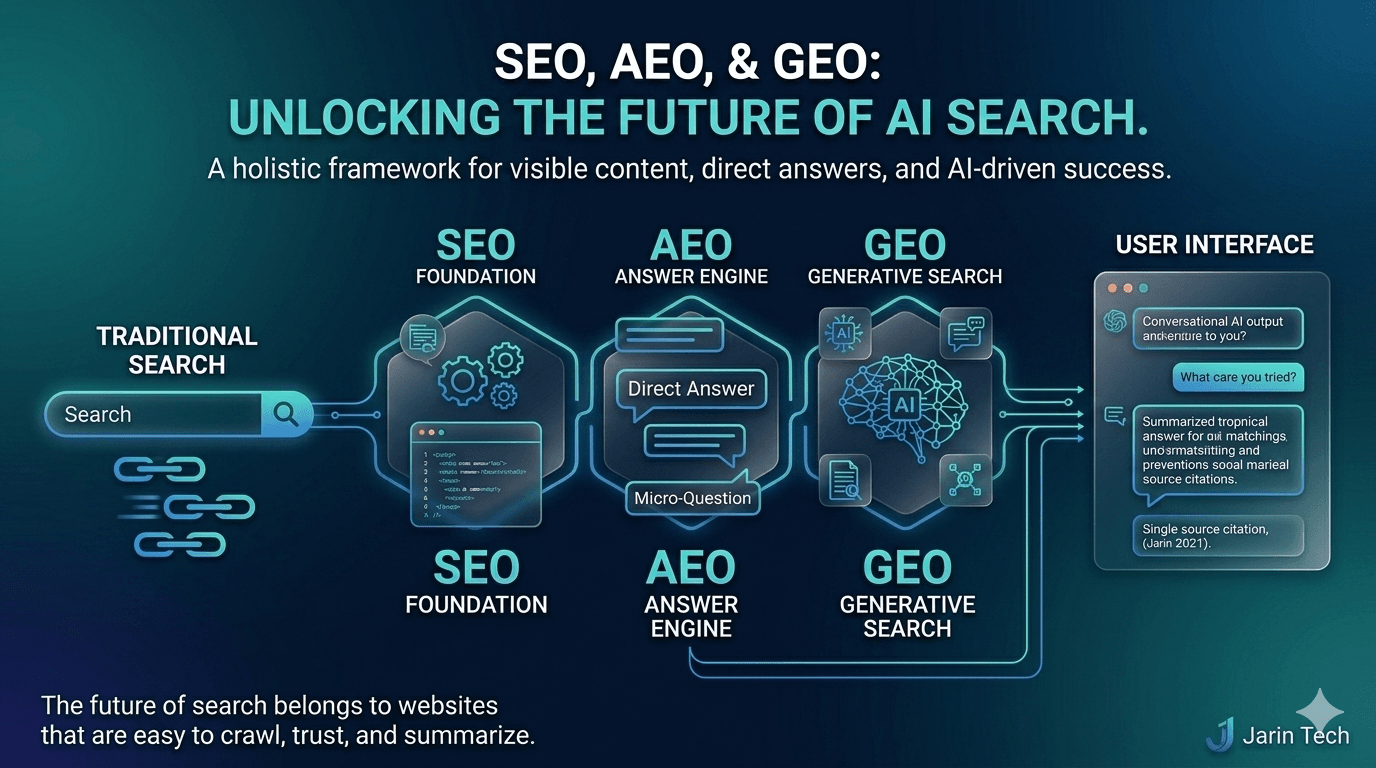
This is exactly why modern visibility requires:
- SEO for rankings and technical foundations
- AEO for answer-focused formatting and question matching
- GEO for AI visibility, topical authority, and generative discoverability
Jarin Tech already frames its services around this future-of-search model, especially through its SEO, AEO, and GEO positioning.
Start with intent, not just the keyword
The keyword “how to optimize for AI and generative search” is not just informational. It has practical intent. The user wants a framework they can apply.
So instead of writing a vague trend article, build your page around the actual questions behind the query:
- What is AI and generative search?
- How is it different from normal SEO?
- What should I change on my website?
- Does structure matter?
- Does schema matter?
- How do I become a trusted source?
Google’s people-first content guidance remains the best foundation here. Content should help users, show real value, and avoid being produced mainly to manipulate rankings.
Create answer-ready content
One of the best ways to optimize for AI and generative search is to make your content easy to lift into a direct answer.
Use a direct introduction
Your first paragraph should clearly answer the main question. This helps readers immediately and increases the chance that AI systems understand the page purpose quickly.
Use question-based headings
Write headings that mirror how people search. AI systems and search engines both benefit from pages with clear topical structure.
Answer first, expand second
Under each heading, begin with a concise answer in 2–4 sentences. Then add detail, examples, or context.
Use lists, steps, and short definitions
Generative systems are better at extracting clean information from well-structured content than from long, unfocused paragraphs.
For example, instead of writing a broad block of text, write a section like this:
Optimizing for AI and generative search means making your content clear, useful, structured, and trustworthy so search engines and AI systems can confidently surface it in answers.
That is easy to understand, easy to quote, and easy to summarize.
Strengthen E-E-A-T signals
In AI-driven search, credibility matters even more. If your page lacks trust signals, it becomes harder for both users and systems to rely on it.
To strengthen E-E-A-T on your blog posts:
- publish under a real author name
- add a short author bio with expertise
- include updated dates where needed
- cite trusted sources for factual claims
- connect the article to your services and company identity
- keep the content specific, not generic
Google’s guidance consistently prioritizes helpful, reliable, people-first content, which directly supports this approach.
For Jarin Tech, this article should ideally be published under a named expert rather than a generic admin profile, especially since the brand already presents itself as an SEO, AEO, and GEO specialist.
Structure content so AI can extract it easily
A major part of generative search optimization is formatting. Good information can still under perform when the structure is weak.
Use these content blocks where relevant:
- short definitions
- step-by-step sections
- comparison blocks
- FAQs
- checklists
- key takeaways
- summary paragraphs
Each section should do one job well. When one paragraph tries to define, compare, explain, and persuade all at once, it becomes harder to parse.
This is why answer-focused formatting is such a strong overlap between AEO and GEO.
Use schema markup to improve understanding
Structured data does not guarantee rankings or AI citations, but it helps search engines understand your page more accurately. Google recommends structured data as a machine-readable way to help search systems interpret content, and article markup is especially relevant for blog posts.
For this post, the best fit is:
- Article schema
- Organization schema
- Breadcrumb schema
- FAQ schema if the FAQ section is kept on-page and valid
Use clean JSON-LD and ensure the visible content matches the markup.
Do not rely on low-value AI content
AI can accelerate content workflows, but it should not replace editorial quality. Google’s guidance on AI-generated content makes the key point clear: automation is not the issue by itself; the issue is low-value, unhelpful, or scaled spam-like publishing.
The right workflow is:
- Use AI for ideation, clustering, and outlining
- Add expert structure and search intent mapping
- Insert original insight, examples, and positioning
- Fact-check claims and remove fluff
- Edit for clarity, readability, and authority
That is how you publish content that is useful enough to rank and strong enough to be cited.
Make sure your technical SEO is clean
Even excellent content will struggle if search engines cannot properly access or understand the site.
Your AI-search-ready content should sit on a website with:
- crawlable pages
- internal linking
- descriptive anchors
- fast mobile performance
- clean heading structure
- correct canonical usage
- strong metadata
- indexable key pages
Google’s Search Essentials and SEO documentation remain the foundation here.
For broader AI discoverability, OpenAI also documents that public websites can appear in ChatGPT search and that site owners can manage crawler access through directives such as OAI-SearchBot in robots controls.
Build topical authority, not one-off content
If you want stronger visibility in AI and generative search, do not stop with one article.
Instead, build a topic cluster around this page. That tells search engines and AI systems that your site has depth on the subject.
A strong Jarin Tech cluster around this article could include:
- what is generative engine optimization
- SEO vs AEO vs GEO
- how AI Overviews impact organic traffic
- how to structure content for answer engines
- the role of schema in AI visibility
- content strategies for AI search
- technical SEO for AI-ready websites
This clustering approach fits Jarin Tech’s existing public content footprint, which already includes GEO, AEO, SEO, AI-focused SEO, and local search topics.
Final thoughts
If you want to know how to optimize for AI and generative search, do not chase gimmicks. Focus on the fundamentals that actually scale:
- understand intent
- answer clearly
- structure content well
- build trust
- support the page with technical SEO
- create topical depth
The future of search belongs to websites that are easy to crawl, easy to trust, and easy to summarize.
At Jarin Tech, that is exactly how we approach modern organic visibility: SEO for rankings, AEO for direct answers, and GEO for AI search presence.
FAQ Section
What is the best way to optimize for AI and generative search?
The best approach is to create people-first content that answers questions clearly, uses clean structure, demonstrates expertise, and sits on a technically strong website. Google’s AI feature guidance says many of the same fundamentals that work in Search also support visibility in AI experiences.
Is SEO still important in generative search?
Yes. SEO remains the foundation because search engines still need to crawl, index, and understand your pages before they can perform well.
What is the difference between SEO, AEO, and GEO?
SEO focuses on traditional search visibility, AEO focuses on becoming the best direct answer, and GEO focuses on making your content and brand more visible in AI-driven and generative search environments.
Does schema markup help AI search?
Schema helps search engines understand page content more clearly. It is a supporting signal, not a shortcut, but it strengthens machine readability.
Can AI-written content rank on Google?
Yes, but only if it is genuinely useful and valuable. Google warns against scaled low-value content and evaluates content quality rather than simply how it was produced.
Still missing your answer, what you are looking for? Please contact Jarin Tech for more or follow us at Facebook at Jarintechbd