AI SEO Finland: How Finnish Businesses Can Prepare for AI Search
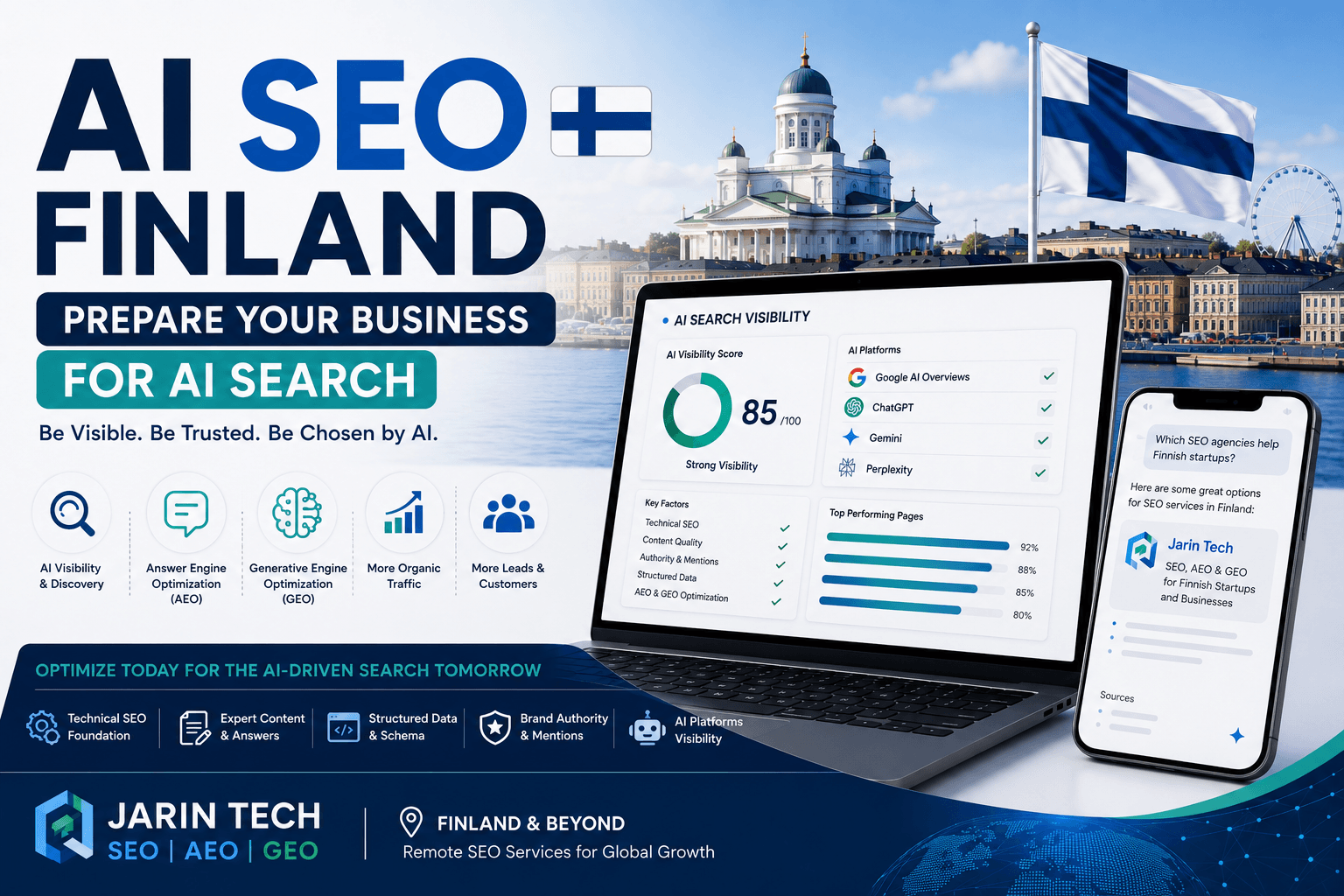
Search is changing fast. Finnish businesses can no longer depend only on traditional Google rankings, paid ads or social media visibility. People are now using Google AI Overviews, ChatGPT, Gemini, Perplexity and other AI-powered tools to compare companies, understand services and make buying decisions. That is why AI SEO Finland is becoming an important topic for startups, SaaS companies, e-commerce brands and service businesses that want to stay visible in the next stage of search.
In the past, a business mainly wanted to appear on the first page of Google. That still matters. However, users now ask more direct questions, such as “Which SEO agency can help Finnish startups?”, “What is the best software for small businesses in Europe?” or “How can a SaaS company improve organic visibility?” AI tools often answer these questions by summarising information from different sources.
If your business is not clearly explained, trusted and visible online, AI search systems may not understand or mention your brand. This is where AI SEO, AEO and GEO become important.
What Is AI SEO?
AI SEO is the process of improving your online presence so your business can be better understood, discovered and referenced by AI-powered search systems.
It is not a replacement for traditional SEO. Instead, it builds on it.
Traditional SEO focuses on helping pages rank in search engines. AI SEO focuses on helping your brand, services, products and expertise become clear enough to appear in AI-generated answers, summaries and recommendations.
AI SEO can include:
- Technical SEO
- Content optimisation
- Entity optimisation
- Structured data
- Answer-focused content
- Brand authority building
- Third-party mentions
- Review signals
- Expert profiles
- Case studies
- AI visibility monitoring
- AEO and GEO strategy
For Finnish businesses, this matters because AI search is changing how users discover products, agencies, consultants and software providers.
Why AI SEO Matters for Finnish Businesses
Finland has a strong startup, SaaS, technology and B2B environment. Many companies are not only targeting Finnish customers but also users in the UK, Ireland, Europe and the United States.
That makes search visibility more competitive.
AI SEO can help Finnish businesses:
- Build stronger brand visibility
- Get discovered in AI-assisted search
- Support traditional Google rankings
- Improve topical authority
- Make services easier to understand
- Strengthen international search presence
- Increase trust through clear information
- Support lead generation
- Prepare content for future search behaviour
- Reduce dependence on paid traffic
For startups and SaaS companies, AI SEO is especially useful because potential customers often research before booking a demo or contacting sales. They compare options, read guides, ask AI tools for recommendations and search for alternatives.
If your company appears in those discovery moments, it has a better chance of entering the buyer’s shortlist.
AI SEO Is Not Just About ChatGPT
Many people think AI SEO only means “how to get mentioned in ChatGPT.” That is too narrow.
AI SEO is connected to a wider search ecosystem, including:
- Google Search
- Google AI Overviews
- ChatGPT
- Gemini
- Perplexity
- Bing Copilot
- Voice assistants
- Answer engines
- AI-powered recommendation tools
Each platform works differently. However, they all need clear, reliable and well-structured information to understand a business.
That means your website, content, brand mentions, reviews, profiles and external references should all support the same message.
If your website says one thing, your LinkedIn says another, your directories have outdated information and your service pages are thin, AI systems may struggle to understand your business correctly.
AI SEO, AEO and GEO: What Is the Difference?
AI SEO often includes two important concepts: AEO and GEO.
AEO: Answer Engine Optimization
AEO means Answer Engine Optimization. It focuses on creating content that answers user questions clearly and directly.
For example, instead of writing a vague paragraph about technical SEO, you can answer:
Technical SEO is the process of improving a website’s structure, crawlability, indexing, speed and technical signals so search engines can access and understand the site properly.
This kind of answer is useful for users, search engines and AI systems.
AEO works well for:
- FAQs
- How-to guides
- Definitions
- Comparison content
- Service explanations
- Step-by-step guides
- Problem-solving articles
GEO: Generative Engine Optimization
GEO means Generative Engine Optimization. It focuses on improving how a brand can be understood, cited or recommended by generative search platforms.
GEO looks beyond one webpage. It considers your overall brand footprint.
This can include:
- Website content
- Brand consistency
- Third-party mentions
- Reviews
- Author profiles
- Case studies
- Business directories
- Structured data
- Original insights
- Trust signals
For Finnish businesses, GEO can be useful when targeting global customers because AI search often relies on broader brand signals, not only one page.
Start with a Strong Technical SEO Foundation
AI SEO does not work well if your website has poor technical SEO.
Before trying to appear in AI search, make sure search engines can crawl and index your website properly.
Check:
- Robots.txt
- XML sitemap
- Canonical tags
- Indexing status
- Broken links
- Redirects
- Page speed
- Core Web Vitals
- Mobile usability
- Internal linking
- Structured data
- HTTPS security
- Duplicate content
- JavaScript rendering
For Finnish startups and SaaS companies, technical issues often appear after redesigns, CMS changes, product updates or landing page tests.
If important pages are not indexed, AI systems may also have less reliable access to your business information.
Technical SEO is the foundation. AI SEO builds on top of it.
Make Your Business Easy to Understand
AI search systems need clear information. Your website should explain your business in a direct and structured way.
Your homepage and About page should clearly answer:
- What does your company do?
- Who do you help?
- Which countries or markets do you serve?
- What services or products do you offer?
- What problems do you solve?
- Why should someone trust you?
- How can customers contact you?
Avoid vague statements like:
We help businesses grow with innovative solutions.
Instead, write something more specific:
We provide technical SEO, AEO and GEO support for Finnish startups, SaaS companies and small businesses that want to improve organic visibility in Finland and international markets.
The second version is clearer. It includes the service, audience and market.
AI SEO depends heavily on clarity.
Build Detailed Service and Product Pages
Thin service pages are a common problem. Many businesses write only a few short paragraphs and expect the page to rank or be understood by AI tools.
A strong service or product page should include:
- Clear H1 heading
- Service explanation
- Target audience
- Problems solved
- Deliverables
- Process
- Benefits
- Use cases
- Proof or examples
- FAQs
- Internal links
- Clear CTA
For example, a Finnish SaaS company should not only describe product features. It should also explain use cases, industries, integrations, customer problems and practical outcomes.
A service business should avoid listing services without detail. Each important service should have its own page.
For AI SEO Finland targeting, this is very important because generic pages are harder to understand and harder to recommend.
Use Question-Based Content
AI search is strongly connected to questions. Users ask natural questions and expect direct answers.
Finnish businesses should create content around real customer questions.
Examples:
- What is AI SEO?
- How can Finnish startups improve organic traffic?
- How does GEO help SaaS companies?
- What is the difference between SEO and AEO?
- How can a business appear in ChatGPT?
- Why is technical SEO important for AI search?
- How can companies prepare for Google AI Overviews?
- What content helps AI tools understand a brand?
Each article should give a clear answer early, then explain the topic in detail.
This structure helps readers and supports AI search visibility.
Strengthen Brand Entity Signals
A brand entity is how search engines and AI systems understand your business as a distinct organisation.
To build strong entity signals, keep your business information consistent across the web.
Use the same:
- Company name
- Logo
- Website URL
- Business description
- Address, if relevant
- Phone number
- Social media profiles
- Founder or team information
- Service descriptions
- Industry category
Your website should connect to your external profiles, such as LinkedIn, Google Business Profile, relevant directories and professional platforms.
For Finnish businesses targeting international markets, consistency is even more important. If your brand information appears differently across countries or directories, it can weaken trust.
Add Structured Data
Structured data helps search engines understand the type of information on your website.
Useful schema types include:
- Organization schema
- LocalBusiness schema
- Service schema
- Article schema
- FAQ schema
- Product schema
- SoftwareApplication schema
- Person schema
- Breadcrumb schema
- Review schema, where appropriate
For SaaS companies, SoftwareApplication schema may be useful. For agencies and service businesses, Organization and Service schema are important.
Do not add false or hidden information. Schema should match what users can see on the page.
Structured data alone will not guarantee AI visibility. However, it supports clarity and machine understanding.
Publish Expert Content
AI search systems are more likely to rely on content that appears useful, specific and trustworthy.
Finnish businesses should publish content that shows real expertise.
Good content examples include:
- Practical guides
- Industry insights
- Original research
- Case studies
- Comparison articles
- Technical checklists
- Customer problem guides
- Data-backed articles
- Product education pages
- Expert opinion pieces
Avoid publishing generic content that could apply to any business in any country. Instead, write from your market, product and customer experience.
For example, a Finnish SaaS startup could publish content about scaling B2B software visibility in Europe. A Finnish e-commerce brand could publish guides around product search, category SEO and conversion-focused content.
Specific content builds stronger authority.
Create Clear Author Profiles
Author credibility matters.
Each important article should show who wrote or reviewed it. The author profile can include:
- Name
- Role
- Experience
- Area of expertise
- LinkedIn profile
- Other published articles
- Company connection
For technical, financial, health or B2B topics, visible expertise can strengthen trust.
If your founder, SEO specialist, product expert or consultant writes content, make that clear.
AI search visibility is not only about the page. It is also about who is behind the information.
Build Third-Party Mentions
Your own website is important, but third-party mentions can strengthen trust.
Finnish businesses can build mentions through:
- Startup directories
- SaaS directories
- Industry blogs
- Local business directories
- Partner websites
- Podcast interviews
- News features
- Guest articles
- Event pages
- Conference speaker profiles
- Client case studies
- Review platforms
These mentions help search engines and AI systems see that the business exists beyond its own website.
For startups, this can also support investor trust, customer trust and international credibility.
Use Case Studies and Proof
AI SEO becomes stronger when your business has proof.
Publish case studies that explain:
- The client or project type
- The initial problem
- The work completed
- The timeline
- The tools used
- The result
- Lessons learned
Do not invent results. Use real data where possible.
For example:
- Organic traffic growth
- Keyword visibility improvement
- Demo requests
- Conversion improvement
- Technical issues fixed
- Indexing improvements
- Local visibility growth
Proof helps users trust your business and gives AI systems more concrete information to understand your expertise.
Optimise for International Search
Many Finnish businesses serve more than one market. If your company targets Finland, the UK, Ireland, Europe or the United States, your SEO structure should support that.
International SEO may include:
- Country-specific pages
- Market-specific keyword research
- UK English spelling for UK pages
- Proper hreflang, where needed
- Localised examples
- Market-specific testimonials
- Country-specific FAQs
- Clear pricing or currency guidance
- Regional case studies
Do not create duplicate country pages with only the country name changed. Each page should be useful for that audience.
For AI SEO, international clarity matters because AI tools may compare your company with competitors in different markets.
Monitor AI Visibility
AI visibility should be checked regularly. It is not enough to assume that your brand is appearing.
You can test different questions, such as:
- What are good SEO agencies for Finnish startups?
- Which companies help with AI SEO in Finland?
- How can Finnish SaaS companies improve organic visibility?
- What is GEO for European businesses?
- Which agencies provide remote technical SEO audits for Finland?
- What does [your brand name] do?
Record the answers over time.
Check:
- Is your brand mentioned?
- Is the information accurate?
- Are competitors appearing?
- Which sources seem influential?
- Are your services missing?
- Is your positioning unclear?
This process can reveal content gaps, authority gaps and brand consistency problems.
Common AI SEO Mistakes to Avoid
Many businesses approach AI SEO in the wrong way.
Avoid these mistakes:
- Ignoring traditional SEO
- Publishing vague content
- Using copied or thin articles
- Having no clear service pages
- Forgetting technical SEO
- Not using structured data
- Keeping outdated company information
- Having inconsistent brand details online
- Ignoring reviews and third-party mentions
- Publishing content without author information
- Overusing keywords unnaturally
- Expecting instant AI visibility
- Claiming guaranteed ChatGPT rankings
AI SEO is not a shortcut. It is a long-term visibility strategy built on clarity, authority and usefulness.
How Jarin Tech Can Help Finnish Businesses
Jarin Tech provides remote SEO, technical SEO, AEO and GEO support for Finnish startups, SaaS companies, e-commerce businesses and service providers.
Our AI SEO support can include:
- AI visibility audit
- Technical SEO audit
- Brand entity review
- Service page optimisation
- Question-based content planning
- AEO content structure
- GEO strategy
- Structured data guidance
- Internal linking review
- Search Console analysis
- Content gap research
- Competitor visibility review
- Monthly reporting
We are based in Bangladesh and work remotely with international businesses across Finland, the UK, Ireland and Europe. Our goal is to help businesses improve visibility across Google Search, Google Maps and AI-powered search platforms.
Conclusion
AI SEO Finland is about preparing your business for the future of search. Traditional SEO still matters, but it is no longer enough to only chase rankings. Your business must be clear, credible and easy to understand across search engines, AI tools and third-party platforms.
Start with technical SEO. Build strong service and product pages. Answer real customer questions. Use structured data. Keep brand information consistent. Publish expert content. Build third-party mentions. Add case studies and monitor your AI visibility over time.
For Finnish startups and growing businesses, AI SEO can create an early advantage. The companies that prepare now will be better positioned as search behaviour continues to evolve.
If your business wants to improve visibility in Google, ChatGPT, Gemini, Perplexity and AI-driven search results, Jarin Tech can review your current presence and create a practical AI SEO roadmap.
FAQs About AI SEO Finland
What is AI SEO?
AI SEO is the process of improving your website, content and brand presence so AI-powered search systems can better understand, reference and recommend your business.
Is AI SEO different from traditional SEO?
Yes, but they are connected. Traditional SEO focuses on search rankings, while AI SEO also focuses on visibility in AI-generated answers, summaries and recommendations.
Why is AI SEO important for Finnish businesses?
Finnish businesses often compete internationally. AI SEO helps improve brand clarity, authority and visibility across Google AI Overviews, ChatGPT, Gemini, Perplexity and other AI search tools.
What is the difference between AEO and GEO?
AEO focuses on answering user questions clearly. GEO focuses on helping generative AI platforms understand and mention your brand in relevant answers.
Can AI SEO guarantee that my business appears in ChatGPT?
No. No ethical provider can guarantee specific ChatGPT mentions. However, AI SEO can improve the signals that help AI systems understand and trust your business.
Can Jarin Tech help with AI SEO for Finnish businesses?
Yes. Jarin Tech provides remote AI SEO, AEO, GEO and technical SEO support for Finnish startups, SaaS companies, e-commerce businesses and service providers.
If you like this blog please check our social presence in linktree